he severing of diplomatic relations between Algeria and the United Arab Emirates, decided on Sep 10, 2026 following what Algiers describes as “provocative or hostile actions”, unleashed a familiar stream of contemptuous comments on social media. Some Emirati accounts readily contrast Abu Dhabi’s wealth, the financial might of its sovereign wealth funds and Dubai’s international prestige with an Algeria they portray as a country left behind. History, however, calls for a little remembrance.
1971: Algeria Takes Back Its Oil
On Feb 24, 1971, Algeria nationalised its hydrocarbons sector. Only eight years after Sonatrach was established, the country believed it had the managers, technicians and state institutions needed to regain control over one of its main sources of wealth.
Such sovereignty cannot be achieved overnight by decree. From the 1960s onwards, Algeria trained engineers, developed Sonatrach, established the Algerian Petroleum Institute and gradually built the expertise needed to negotiate with major foreign companies, then replace them in essential sectors. Two years after nationalisation, Algeria’s experience would prove useful elsewhere.
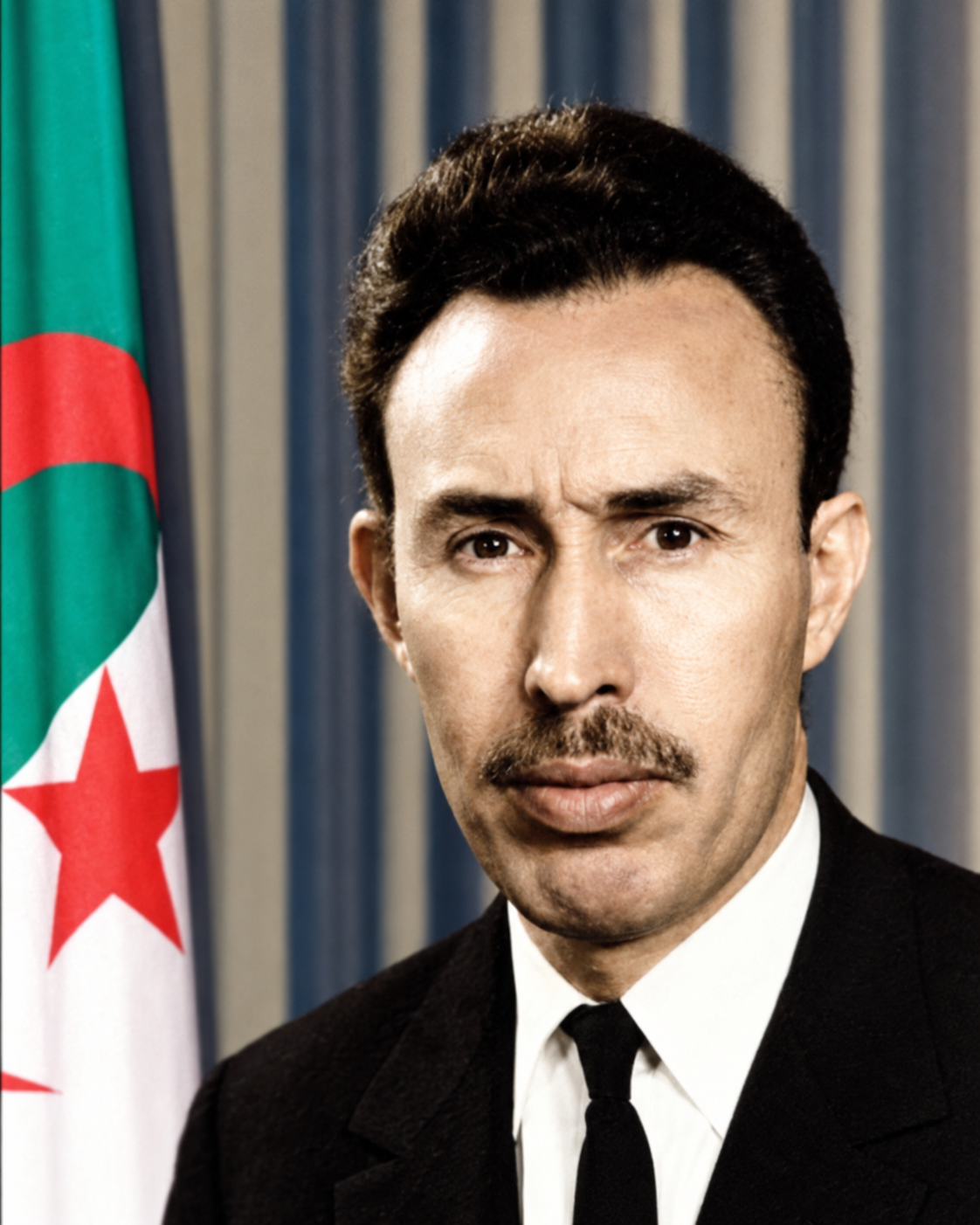
Boumediene Sends Sonatrach Personnel to Abu Dhabi
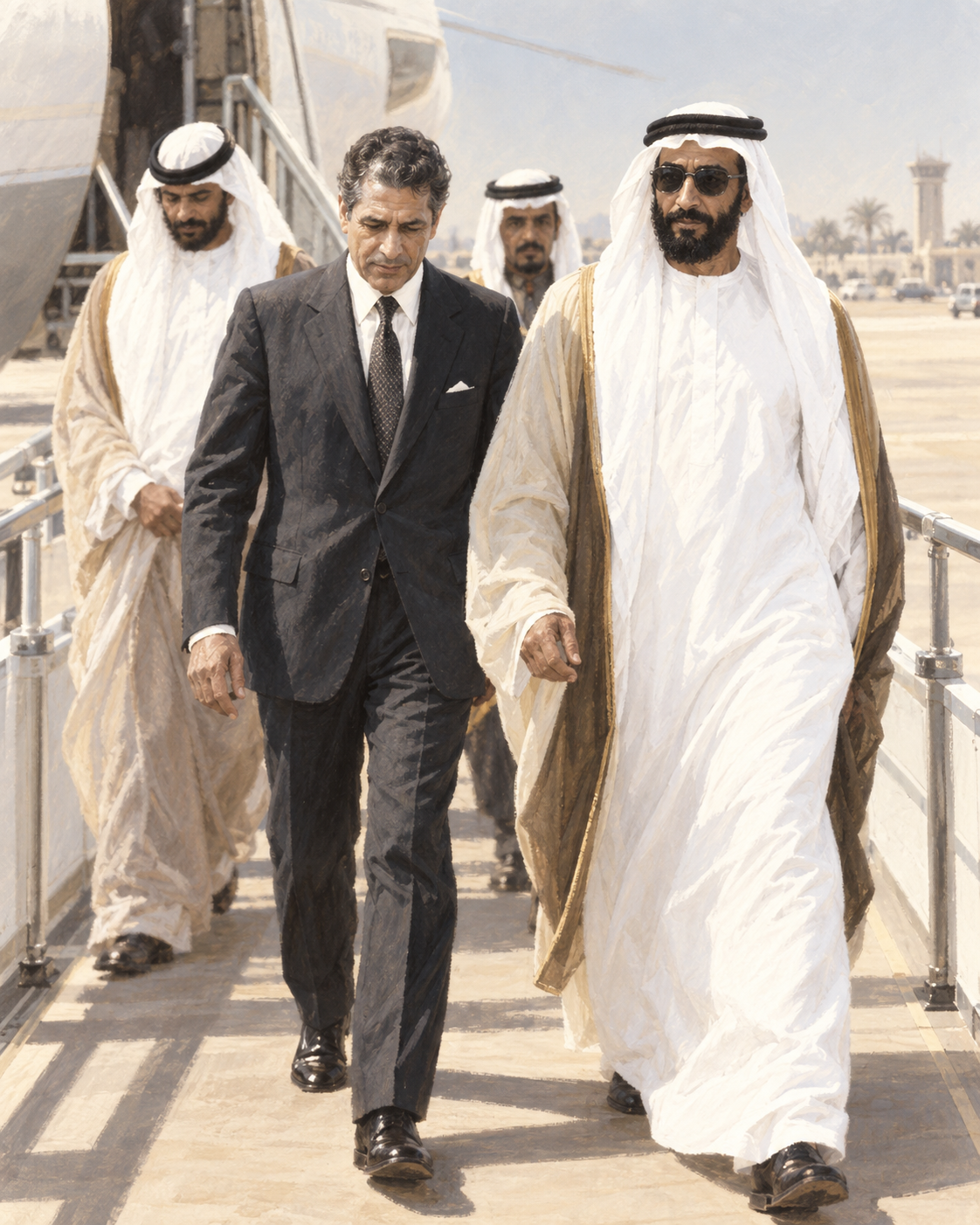
In the early 1970s, Abu Dhabi sought to build its own national capabilities in hydrocarbons. The emirate turned to Algiers. At its leaders’ request, President Houari Boumediene made a team of Algerian managers from Sonatrach available to them.
Heading the team was Mahmoud Hamra Krouha, a senior executive at the Algerian company whose responsibilities included planning. He travelled with a team of Algerian technicians and managers. Krouha became director-general of ADNOC, the Abu Dhabi National Oil Company. The Algerian team helped develop the Emirati national company and train its managers.
A CIA report on oil institutions in producing countries, dated November 1974, gives a measure of the real importance of his role. It describes Sheikh Tahnoun bin Mohammed Al Nahyan, chairman of ADNOC’s board, as influential and intelligent but still inexperienced in oil affairs. It judges that he would probably have to “rely heavily on the advice of Mahmoud al Hamra Krouha”.
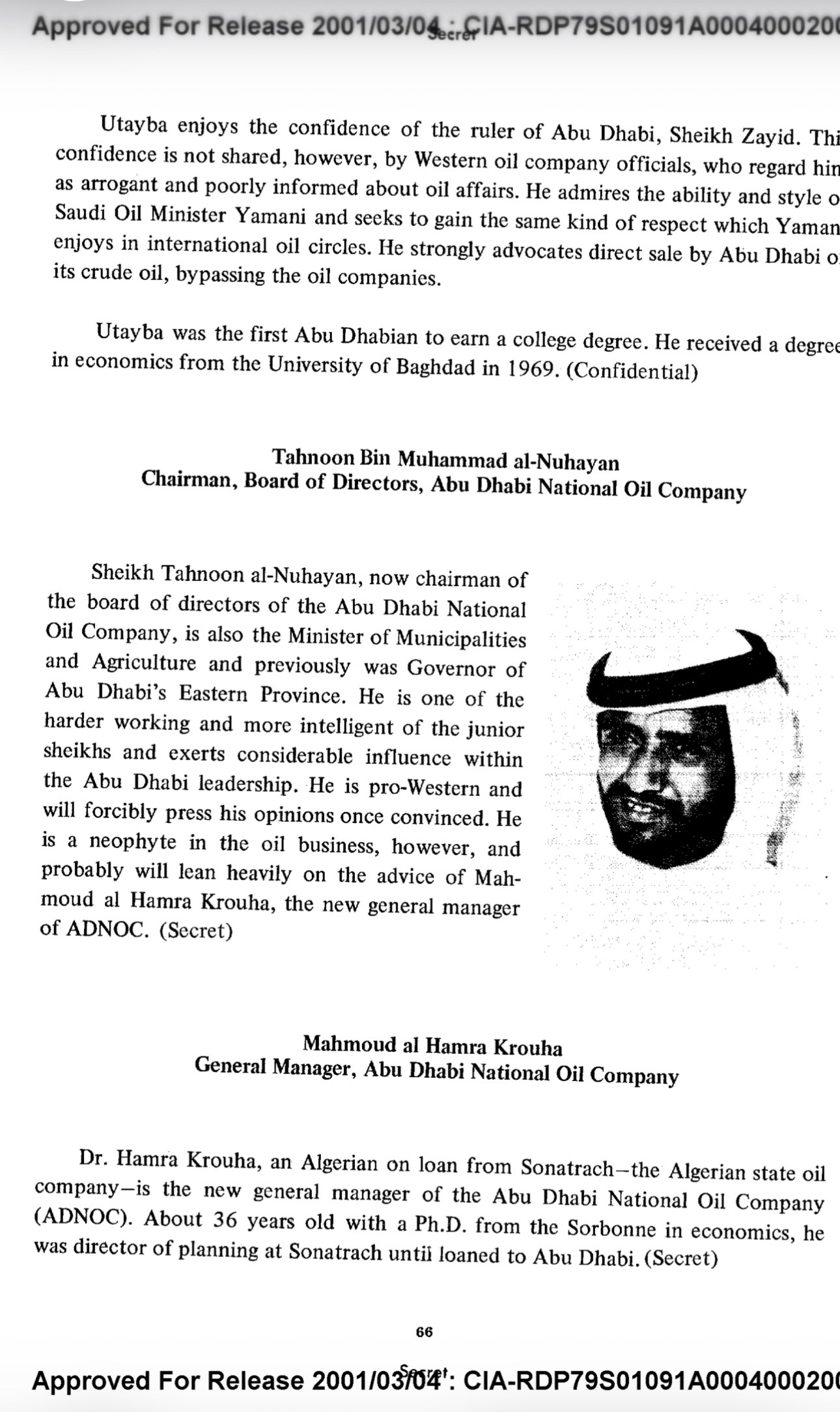
The same report states that ADNOC’s day-to-day operations were run by Krouha, who was seconded from Sonatrach. Algeria therefore provided Abu Dhabi with more than a team of technicians. As the emirate learned to turn its oil into national power, an Algerian executive advised its leaders and took operational charge of the institution responsible for establishing that sovereignty.
Abu Dhabi’s debt to Algiers is neither merely diplomatic nor symbolic. It concerns what would become the very core of its power: national control over its hydrocarbons. A historical debt of this kind is difficult to quantify. In many respects, it is beyond measure.
1973: Foreign Companies Hand Over Distribution
On Jun 1, 1973, another milestone was reached: the foreign companies that had distributed petroleum products in Abu Dhabi transferred that activity to ADNOC. The emirate took direct responsibility for a strategic function within its domestic oil market.
The chronology deserves attention. 1971: Algeria nationalised its hydrocarbons sector. 1973: Abu Dhabi took over the distribution of petroleum products from foreign companies. And an Algerian executive from Sonatrach was then in operational charge of its national company, as ADNOC built its national distribution system.
Abu Dhabi thus owes Algiers part of its education in oil sovereignty: Algeria passed on some of the experience it had just acquired in turning control over a natural resource into an instrument of national sovereignty.
The billions would come later. So would the towers, sovereign wealth funds, airlines, luxury hotels and financial power. But before oil money gave Abu Dhabi the means to look down on the world, it had to learn to control that oil. And among those who taught it were Algerians.
British Concerns
British diplomatic archives also provide a very concrete sense of the influence Algerians acquired in Abu Dhabi. In 1983, more than ten years after their arrival, the British embassy was closely monitoring ADNOC’s “Algerian team”. Mahmoud Hamra Krouha had by then been the company’s director-general for many years. British diplomats were particularly concerned about the team’s influence over the awarding of certain contracts, fearing that French companies might be favoured at the expense of British interests.
The Algerian presence at ADNOC was therefore significant enough to become a matter of diplomatic concern in London. British archives even devote a file to “Algerians in Abu Dhabi National Oil Company”. Krouha would remain at the head of ADNOC for many years, until his departure in 1987. Meanwhile, the Emirati company expanded dramatically. Abu Dhabi now had its own national oil organisation.
So What Happened?
Half a century later, the contrast is striking. How could a relationship that once led Algeria to share its oil expertise with Abu Dhabi result in such hostility? Why has the United Arab Emirates become one of the Arab states whose strategic choices most directly oppose those of Algiers?
Why did Abu Dhabi choose to become a driving force behind normalisation with Israel, establishing diplomatic relations in 2020 under the Abraham Accords, then developing economic, diplomatic, security and defence ties with Israel? Why does this small Gulf federation now wield such harmful influence in several African conflicts?
A favour can be forgotten. One may even consider that gratitude between states never lasts forever. But history is harder to erase. While Abu Dhabi has become immensely rich, its historical debt to Algiers remains beyond measure. This microstate’s ingratitude is inversely proportional to its size.
Loading…