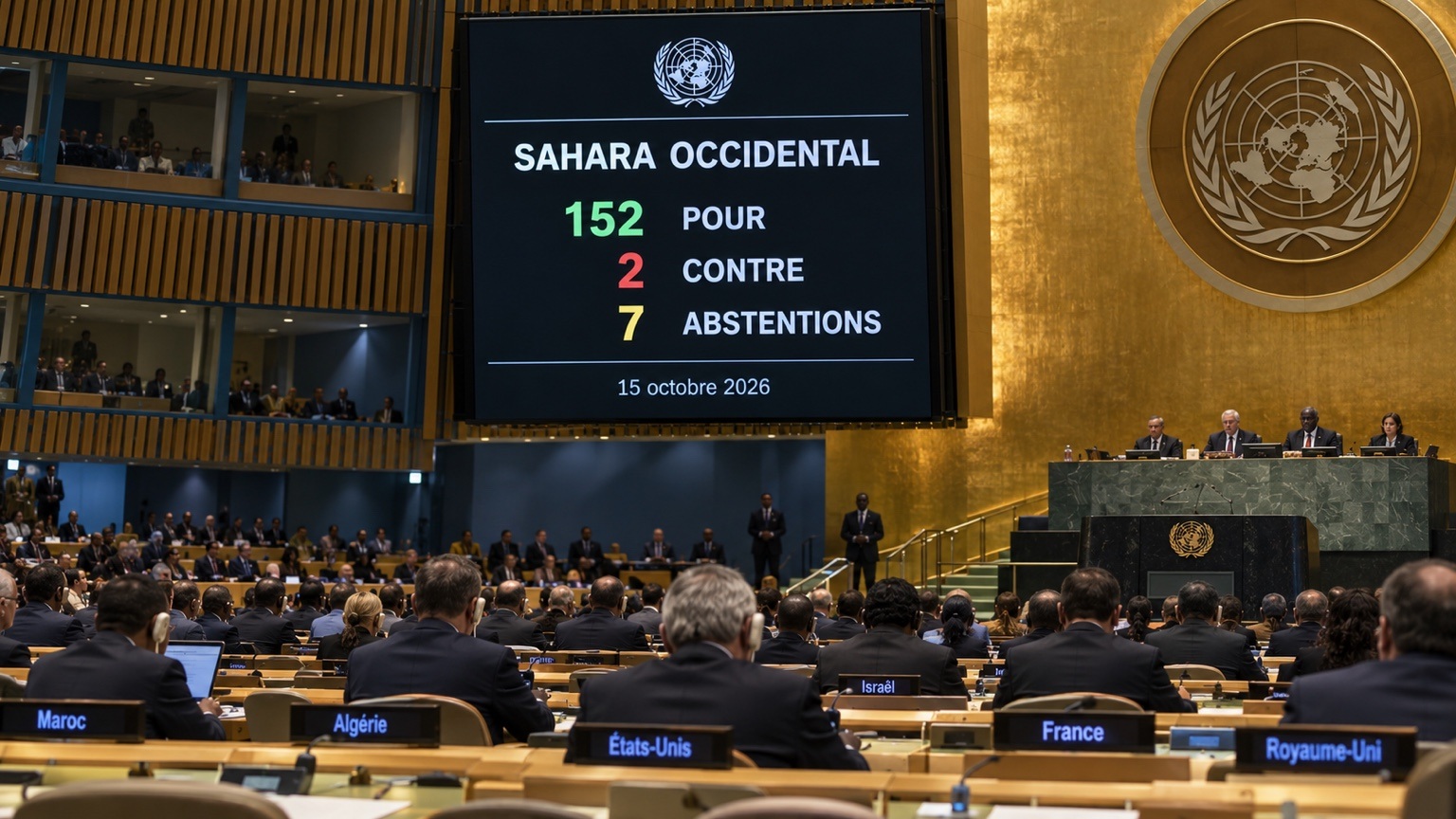
152 in favour. Two against. Seven abstentions.
Some votes matter more for what they reaffirm than for what they change.
On 15 October 2026 in New York, the Fourth Committee of the United Nations General Assembly, whose responsibilities include decolonisation, adopted its annual resolution on Western Sahara by an overwhelming majority. Morocco and Algeria voted in favour. The United States and Israel were the only two states to vote against. France and the United Kingdom abstained, alongside Brunei, Cameroon, Honduras, Liberia and the Maldives.
The figure is striking. But the most important point lies elsewhere: international law has not changed.
Western Sahara remains a decolonisation issue. The territory is still on the United Nations list of Non-Self-Governing Territories. And its people retain their right to self-determination.
Contrary to the narrative Rabat seeks to impose, a few foreign recognitions of the Sahara’s supposed “Moroccan character” cannot erase half a century of international law.
A fait accompli does not create sovereignty
Morocco now controls most of Western Sahara. It has installed its administration, army and infrastructure there, exploits its resources and presents the territory as its “southern provinces”.
But a fait accompli does not create sovereignty.
The UN has never recognised Moroccan sovereignty over Western Sahara.
Since 1963, the territory has been listed among those whose decolonisation remains unfinished. As early as 1979, the General Assembly expressly deplored the “continued occupation of Western Sahara by Morocco”.
Diplomatic circumlocutions can be multiplied at will. The reality remains: a colonised territory, a people denied the effective exercise of its right to self-determination, and an occupying power seeking to turn fifty years of control into a title of ownership.
Morocco is in the wrong in the eyes of the world
152 states voted in favour.
African, Asian, Arab, Latin American and European countries. Allies of Morocco, supporters of the Polisario Front, and states with no particular reason to please Algiers.
They do not all share the same political reading of the conflict. But all approved a text that keeps Western Sahara within the framework of decolonisation and reaffirms the Sahrawis’ right to self-determination.
It must be said plainly: Morocco is in the wrong in the eyes of the world and under international law.
What Rabat possesses is not UN recognition of its sovereignty. It is an advantage in the balance of power.
Morocco relies on the support of a few major powers, particularly on the Security Council, where five states hold veto rights and can prevent the principles reaffirmed by the vast majority of nations from becoming binding decisions.
That is the story of Western Sahara: most of the world invokes the law, while a handful of powers can prevent its enforcement.
On the ground of international law, the outcome is clear. But the game is played again in a far more closed room, where power sometimes carries more weight than principle.
And Rabat relies precisely on that gap to maintain the status quo.
Two against: the United States and Israel
The only two “no” votes came from the United States and Israel.
Two states that readily disregard international law. Washington, which invaded Iraq without a Security Council mandate and whose president openly expresses ambitions over Greenland and Canada. Israel, which continues its settlement of Palestinian territories in defiance of UN resolutions and is committing genocide in Gaza on an unprecedented scale.
Their choice will surprise no one.
On Western Sahara, Washington and Tel Aviv stand alone against 152 states, once again choosing power over a people’s rights.
Paris and London prefer to abstain
Seven states abstained. Two names among them stand out: France and the United Kingdom.
Two former colonial powers that still administer territories on the UN list of Non-Self-Governing Territories.
London administers several. France remains directly concerned by the cases of New Caledonia and French Polynesia.
There is a certain historical consistency in these two powers’ reluctance to vote for a text recalling peoples’ right to determine their own future.
Paris now openly supports Moroccan sovereignty over Western Sahara.
But a statement from the Élysée, however solemn, does not rewrite international law.
Why did Morocco vote in favour?
Seen from outside, Morocco’s vote is surprising. Rabat itself approved a resolution considered by the Decolonisation Committee that reaffirms the Sahrawi people’s right to self-determination.
Seen from within Morocco, however, the vote becomes far less mysterious.
Since the adoption of Security Council Resolution 2797 on 31 October 2025, the Moroccan public has been sold a historic, almost definitive victory. The authorities and much of the media presented the text as international confirmation of Western Sahara’s supposed “Moroccan character”.
King Mohammed VI himself spoke of a “new victorious chapter” intended to settle the issue once and for all.
The triumph was taken to its symbolic conclusion: 31 October became a national holiday, named “Aïd Al Wahda”, Unity Day, to celebrate this supposed diplomatic victory.
A public holiday for a sovereignty the UN has never recognised!
Less than a year later, how could that same public be told that Morocco would vote against a resolution reaffirming the Sahrawi people’s right to self-determination?
Rabat chose another course: vote in favour, then explain that this vote was yet another Moroccan victory.
Official communications therefore immediately seized on the reference to Resolution 2797 in the text of 15 October.
This is where the obfuscation begins.
Yes, Resolution 2797 takes Morocco’s autonomy proposal as the basis for negotiations.
But it requires a “mutually acceptable” solution providing for “the self-determination of the people of Western Sahara”. It envisages genuine autonomy as a possible feasible outcome.
The conditional matters. The parties’ agreement matters. Self-determination matters.
Nowhere does the resolution recognise Moroccan sovereignty over the territory. It does not empower Morocco to impose its plan on the Polisario Front. It does not decide the Sahrawis’ future for them.
But that is plainly not what is emphasised to the Moroccan public.
They are shown the reference to the autonomy plan. They are repeatedly told that 2797 is a victory. A national holiday has even been created to celebrate it.
Much less is said about the “mutually acceptable” solution. And even less about the Sahrawi people’s self-determination.
Perhaps the most remarkable point is this: a government that announced an almost definitive victory to its people finds itself, less than a year later, voting to keep Western Sahara before the UN Decolonisation Committee.
International law has not changed.
What has changed is the story told about it in Morocco.
The Sahrawis have reason to hope
The vote of 15 October will not, by itself, change the balance of power. It will not make the wall disappear, bring Sahrawi refugees home tomorrow or force Rabat finally to organise the referendum awaited for decades.
But it recalls something essential: no balance of power lasts forever.
Algerians know this better than anyone. For more than a century, France presented Algeria as part of itself. It had an infinitely more powerful army, allies, a permanent seat on the Security Council and a diplomatic apparatus capable of presenting the war of independence as a mere “internal affair”.
And yet Algeria became independent.
Because a people refused to surrender its existence, held firm, fought and internationalised its cause until the colonial order became impossible to sustain.
The Sahrawis therefore have reason to hope.
Morocco can rely on a few powers, multiply bilateral recognitions and present every favourable statement as a final victory. It can neither erase a people nor turn occupation into sovereignty through the passage of time.
Algerian history recalls a simple truth: a people may appear defeated for a long time without its story being over.
Western Sahara remains a territory awaiting decolonisation.
And after fifty years of occupation, the principle remains intact:
the last word belongs to the Sahrawi people.
Loading…