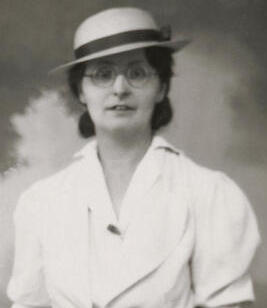
Some myths are remarkably persistent. The claim that Émilie Busquant was the “mother” of the Algerian flag is a story whose seams are all too visible: it is used to support a racist and colonialist thesis, amplified by Morocco’s national narrative, according to which Algeria itself was a French creation. The myth does not withstand history or the archives.
Repeated often enough, the claim has ended up reversing the burden of proof. Those who present Busquant as the creator of the Algerian flag are no longer asked to prove it; instead, those who challenge the claim are expected to disprove it.
So let us turn the question around: what evidence allows the creation of the Algerian flag to be attributed to Émilie Busquant in 1934?
The decisive evidence: 1919–1920
It appears in a historical study published as early as 2004. René Gallissot, in a biographical notice drawing on material from the Dictionnaire biographique du mouvement ouvrier Algérie, devotes several pages to Émilie Busquant. His work relies in particular on police archives, the press, and testimonies collected and critically compared.
Gallissot clearly discusses the general assembly of the Étoile nord-africaine in Levallois-Perret on 5 August 1934, when a green-and-white flag bearing a red star and crescent, presented as the work of Mrs Messali, was hung behind the platform. But, crucially, he states that this was not the flag’s first appearance: Algerian trade-union demonstrators were already displaying it during May Day marches in 1919 and 1920, in Algeria and France, and later in CGTU processions from 1921 onward.
Fifteen years before Émilie Busquant.
This is not a minor chronological detail. It overturns the entire argument. If the flag described in 1934 is already documented in 1919–1920, Busquant may be credited with sewing one example. She cannot be credited with inventing it.
This chronology did not remain buried in an old text. In his 2024 study A Century of Flags: The Three Ages of the Algerian Flag, Salim Chena likewise traces the banner to workers’ demonstrations in France and Algeria as early as 1919–1920. He also stresses that the flag at that stage remained artisanal and had not yet been fully formalised or standardised.
The question is therefore no longer: “Did Émilie Busquant sew a flag?” It is: how could she have invented in 1934 an emblem documented fifteen years earlier?
So what did Émilie Busquant actually do?
She is credited with sewing a flag for the Étoile nord-africaine. But three verbs have gradually been confused: to sew, to design, to invent. They do not mean the same thing.
When we look for the material evidence that would turn the seamstress into the creator, another problem appears: where is the 1934 flag?
To our knowledge, no authenticated photograph allows the flag displayed at the Étoile nord-africaine assembly on 5 August 1934 to be examined precisely today. Nor have we found a surviving example with a sufficiently established provenance to compare it with the present Algerian flag. What we have are descriptions — and they do not all tell exactly the same story.
Was the 1934 flag even the one we know today?
B. Babaci provides a particularly interesting element. In his account of the flag’s origins, he describes work carried out within the Étoile nord-africaine in 1934 on an emblem intended to represent Algeria.
But the model he describes is not the one flying over Algerian public buildings today: it consists of two horizontal bands, one green and one white, with the red crescent and star in the centre.
Horizontal.
The current Algerian flag, by contrast, is divided vertically: green at the hoist, white on the other side, with the red crescent straddling both fields.
Babaci describes several successive configurations before the present form was settled. The distinction is fundamental. Even if Busquant is credited with sewing the flag displayed by the Étoile nord-africaine in 1934, nothing therefore allows that example to be automatically identified with the present Algerian flag.
Family memory also played a role. Djanina Messali-Benkelfat, daughter of Messali Hadj and Émilie Busquant, defended her mother’s role in the history of the flag. But Djanina was born in 1938. She could not have witnessed the sewing attributed to her mother in 1934. Her account necessarily belongs to family memory transmitted after the events. That cannot erase earlier evidence, still less turn sewing into invention.
1945: this time, the design process is documented
The contrast with 1934 is striking. As the demonstrations of May 1945 approached, the PPA leadership wanted a uniform emblem. Hocine Asselah was asked to find an example of the flag with which Messali Hadj had marched in 1937. The search failed.
Chawki Mostefaï recounts that the PPA leadership then asked Hocine Asselah, Chadli El-Mekki and himself to devise one or more designs. This time we have a detailed account of the design process.
Mostefaï arrived at the meeting with a set square, a compass, sheets of white paper, coloured pencils and several sketches. The discussion concerned the position of the star and crescent, the colours and the meaning of the motifs. Then the party leadership decided. The choice fell on “the current model”, Mostefaï writes: the crescent straddling the green and white fields, with the star between its points. That is the arrangement of the Algerian flag we know today.
The chronology then becomes much clearer:
1919–1920: an Algerian banner is already documented in workers’ demonstrations in France and Algeria.
1934: the Étoile nord-africaine uses a green-and-white emblem with a red crescent and star; Émilie Busquant is associated with sewing one example, while Babaci describes a horizontal arrangement.
1945: Mostefaï, Asselah and El-Mekki work on the composition, and the PPA leadership adopts the arrangement corresponding to the present design.
1961–1963: the technical characteristics are standardised before being institutionalised by the law of 25 April 1963.
In the Casbah, women sew hundreds of them
In Algiers, the model adopted by the PPA then had to be turned into hundreds of physical flags. Testimonies collected in Algeria describe a clandestine operation in the lower Casbah.
According to memories preserved by the Omrani family, Fatima and Zohra Omrani took part in sewing the flags in a workshop on Rue Souk El-Djemaa. The fabrics were bought separately, colour by colour, to avoid attracting attention. Finished flags were handed to women activists who presented a password. The family account speaks of around 300 flags sewn on 30 April 1945. The scene recalls an obvious point: sewing the flag is a militant act. It does not make every seamstress its inventor.
Sétif, 8 May 1945
A few days later, the flag entered another history. In Sétif, Bouzid Saâl was shot while carrying the Algerian flag at the head of the procession.
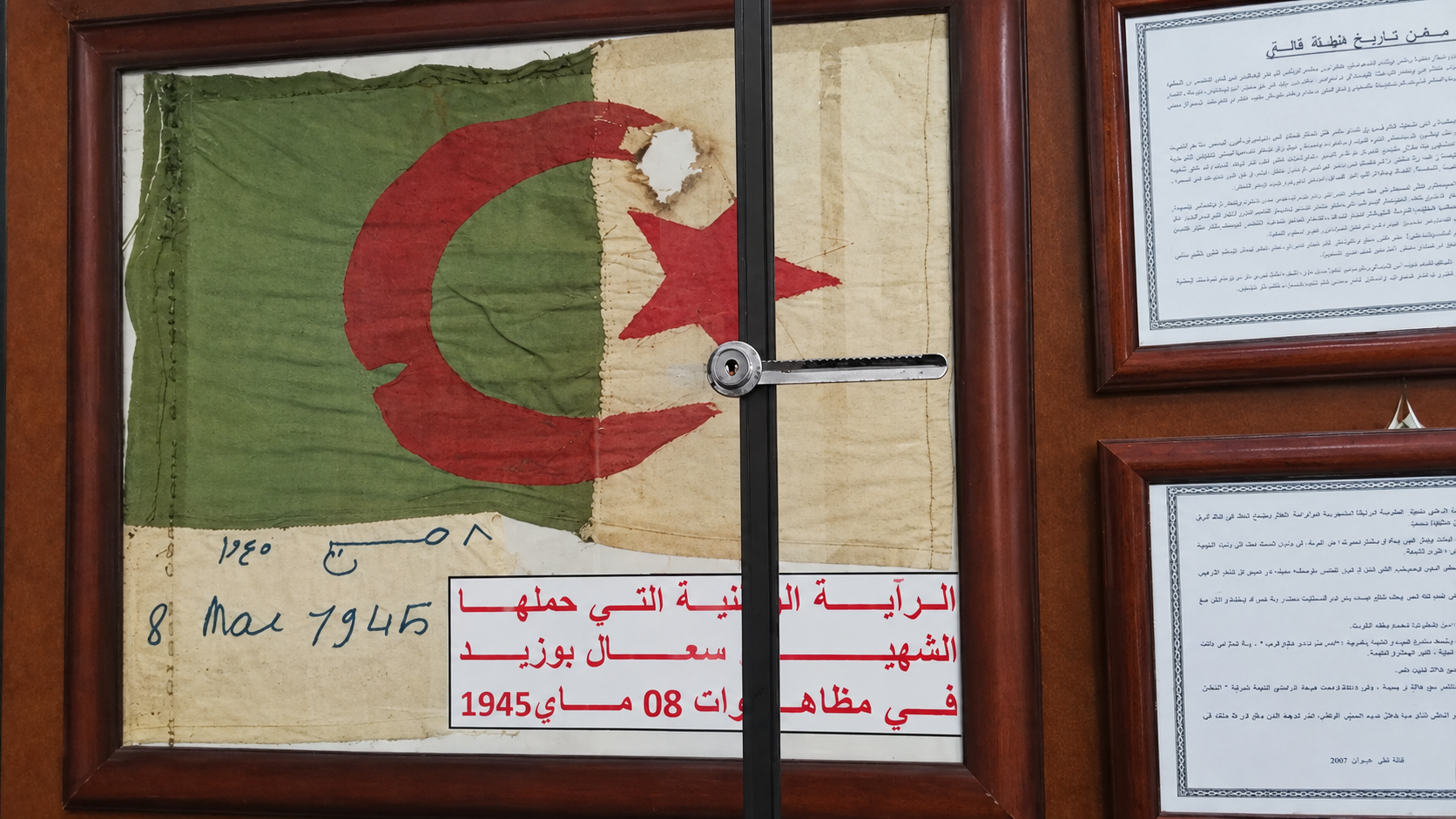
Between the clandestine workshops and the young Algerian who fell while carrying it, the emblem ceased to be merely a design. It became a symbol for which people died.
And before 1919?
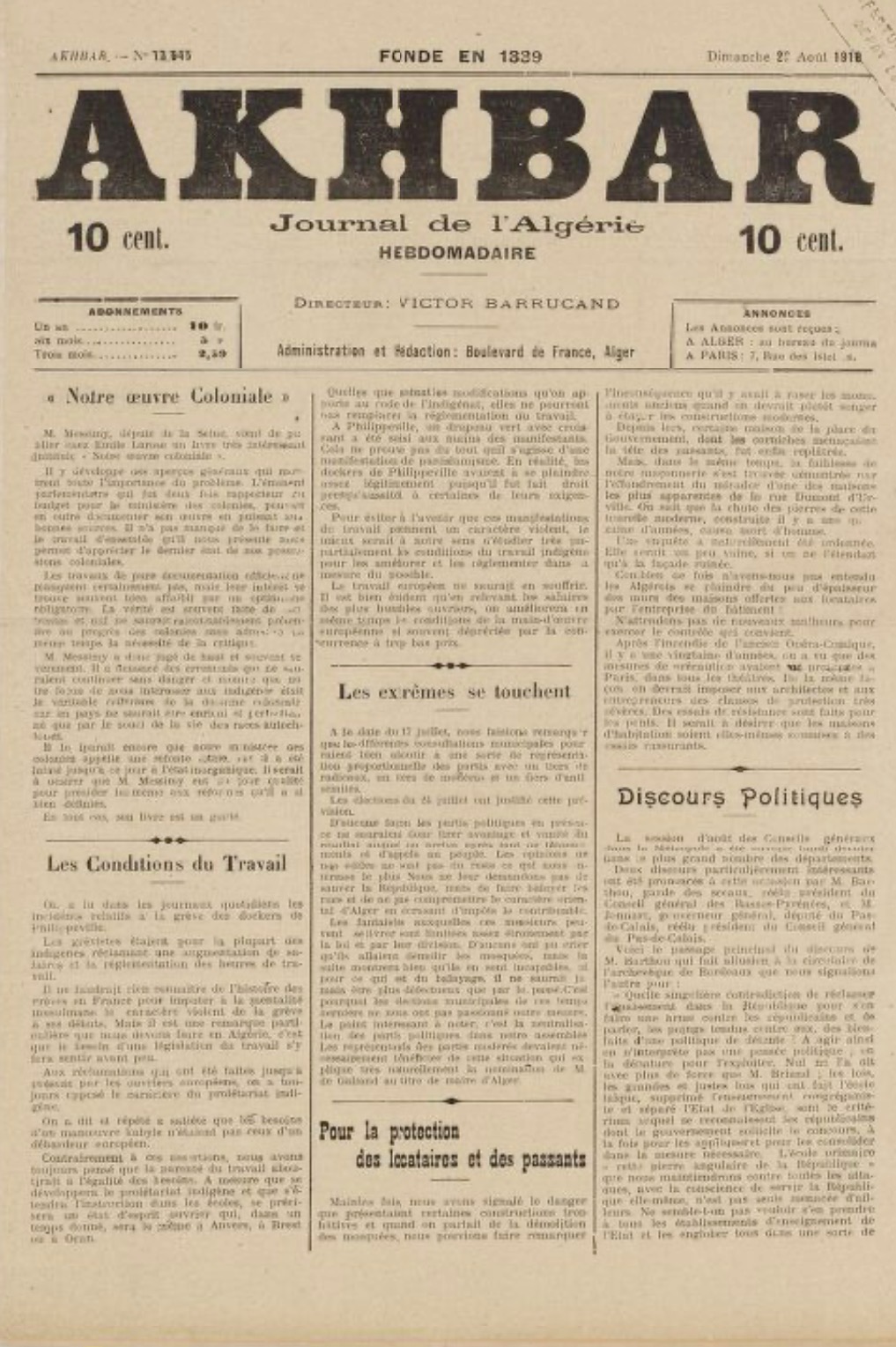
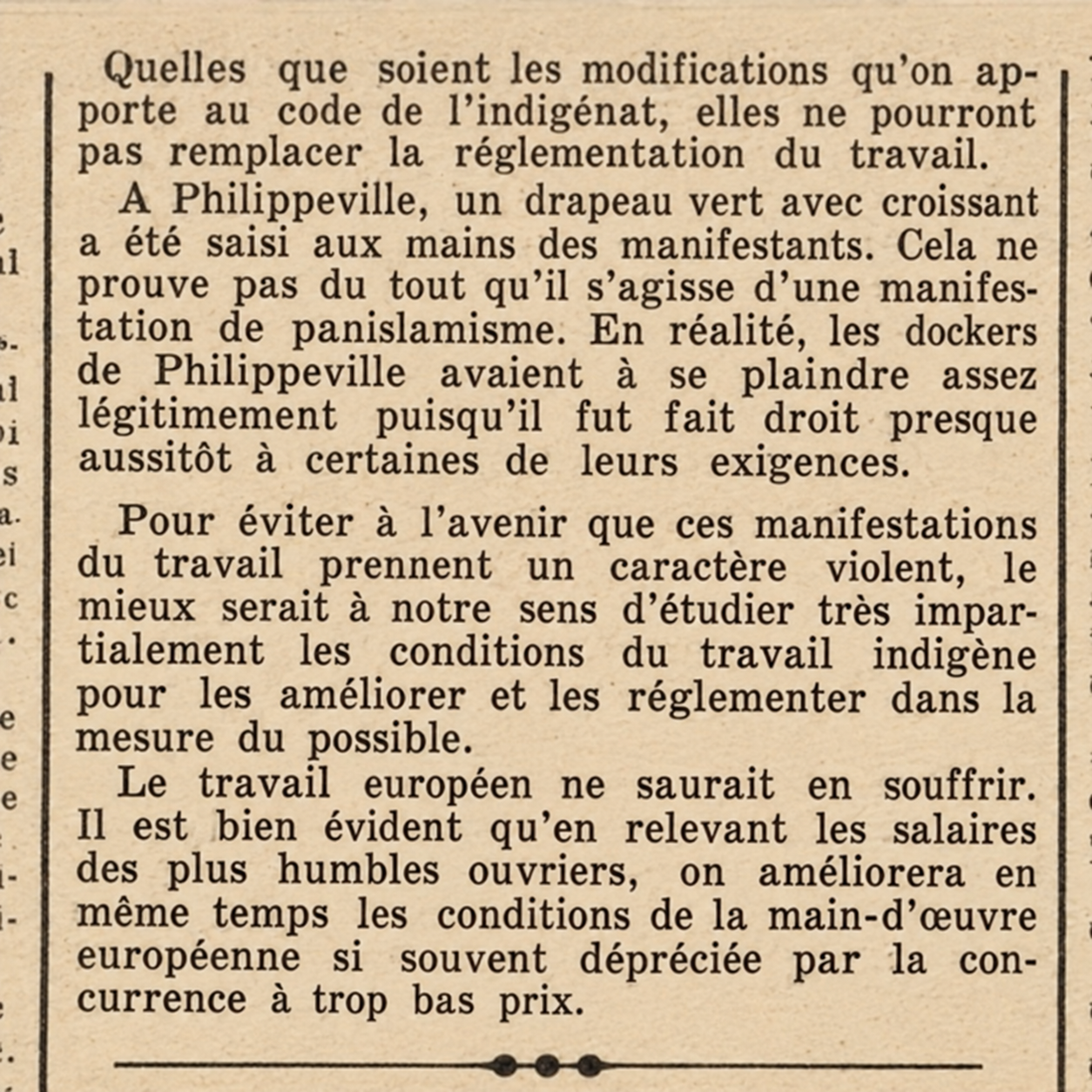
An earlier instance dates back to 1910. In its 28 August issue, Akhbar reported that in Philippeville, now Skikda, “a green flag with a crescent was seized from the demonstrators” during a dockworkers’ strike. The newspaper mentions neither white nor a star in this passage: it documents the use of these symbols in Algerian workers’ struggles, twenty-four years before the episode associated with Émilie Busquant.
The story can be traced further back. Flags of Algiers recorded in the eighteenth century already used green, white and red. The crescent and star had long belonged to the local symbolic vocabulary. In the nineteenth century, Emir Abdelkader led his state and army under their own banners.
It would be artificial to present any of these flags as the direct prototype of today’s Algerian flag. Nor is that necessary.
The strongest evidence lies much closer to us: 1919–1920. Gallissot documents the banner fifteen years before the Busquant episode. For 1934, we have found neither an authenticated photograph nor a surviving example establishing that the flag attributed to Busquant was identical to the present model; Babaci, moreover, describes horizontal bands. In 1945, by contrast, Mostefaï provides a precise account of the collective work that led to the present arrangement.
So why has this history been so heavily focused on Émilie Busquant that the seamstress of one version became the creator of the emblem?
The documented history tells a different story: that of a flag built collectively over several decades, carried by the national movement and ultimately fixed in its present form in 1945. Émilie Busquant sewed one version of the Algerian flag. She did not invent it.
Loading…