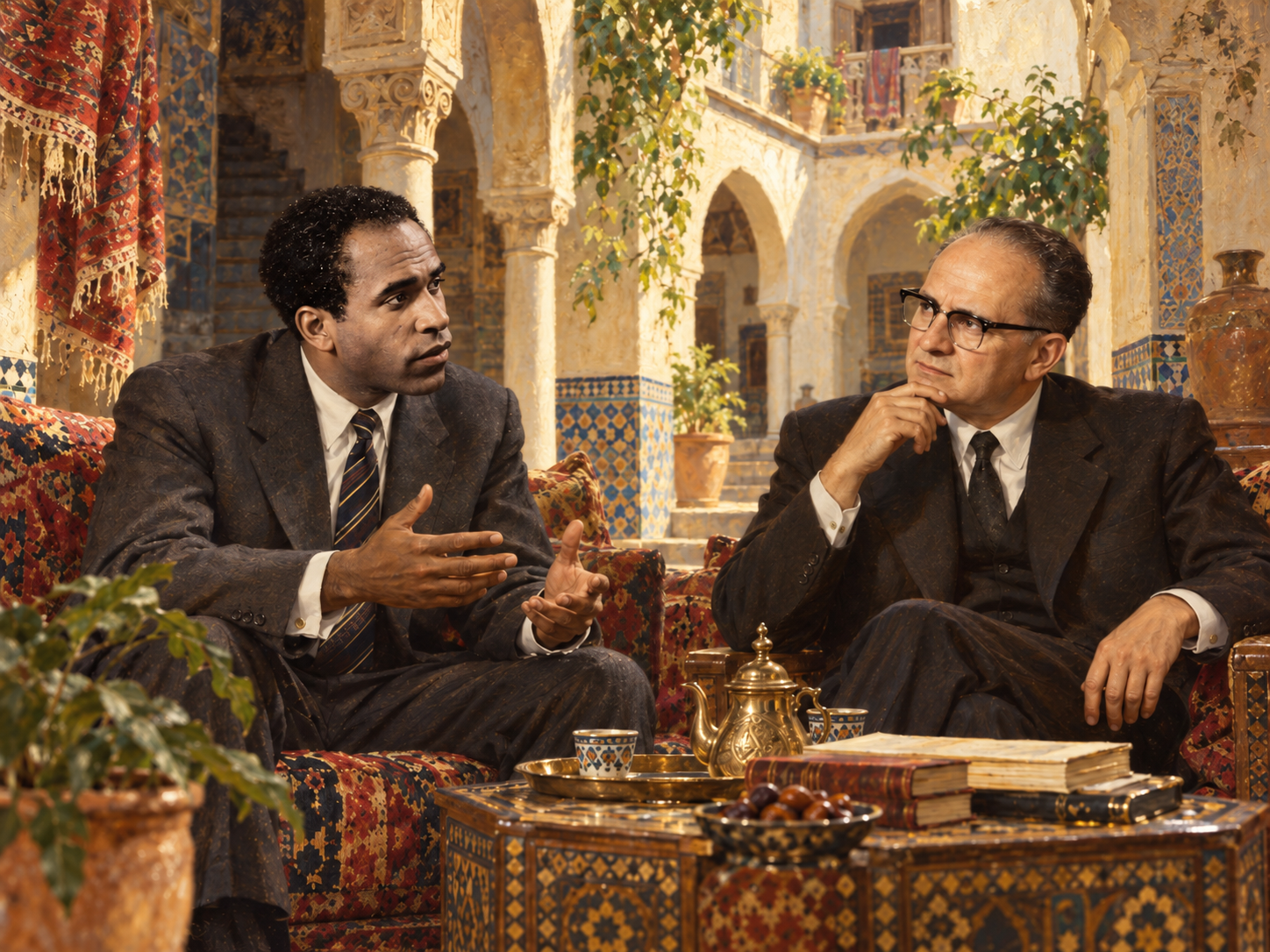
Frantz Fanon dissected the psychological devastation of colonial domination: the alienation that ultimately leads people to see the world — and sometimes themselves — through the eyes of the dominant power. Malek Bennabi developed another concept, “colonisability”, to examine the internal mechanisms that make a society vulnerable to domination. Their ideas are not interchangeable. But more than sixty years after independence, they continue to raise an unsettling question: what remains of colonisation once the coloniser has left? Sometimes, far more than we would care to admit.
When foreign approval becomes a certificate of worth
Just look at scenes that have become commonplace on social media. A foreign YouTuber arrives in Algeria. People want to house him, feed him, pay for his coffee, his meal, his taxi, his souvenir. If he takes out his wallet, they almost make him put it back in his pocket.
Algerian hospitality is longstanding, real and beautiful. This is certainly not an argument for disowning it. But it sometimes turns into something else: a competition in deference. As though welcoming someone properly were no longer enough, and we had to convince the foreign visitor of our generosity at any cost. As though his approval mattered more than our own.
The most revealing thing is not, in fact, what we offer him. It is the value our own country suddenly acquires when he looks at it.
A neighbourhood we disparage becomes magnificent because a French, British or American YouTuber films it. A dish we have known since childhood becomes exceptional because a visitor marvels at it. A road, a hotel, a landscape or a craftsperson is suddenly seen differently because a foreigner has just explained that they are worth something.
Sometimes we wait for permission from outside to love what we have at home.
The same mechanism operates in the economy. How often is a product assumed to be better simply because it is imported? How many Algerian products are judged before they have even been tried? How many swear by Nutella while El Mordjène is acclaimed elsewhere? For some, a foreign “made in” label remains a guarantee of quality in itself, whereas “made in Algeria” must first prove that it is not mediocre.
Of course, not all domestic products are equally good. Blindly defending a poor product because it is Algerian would be just as absurd as blindly preferring a foreign product because it is not. The problem lies elsewhere: in the presumption of superiority granted to whatever comes from outside.
Football offers another illustration. For years, the debate has returned to foreign national-team coaches, players trained in Europe, training academies and local expertise. Dual nationals have contributed enormously to the national team and will continue to do so. Algeria would be wrong to deprive itself of its children trained elsewhere. Likewise, a great foreign coach can obviously contribute experience.
But it becomes worrying when foreign credentials sometimes constitute an argument in themselves, while the essential question remains neglected: what are we producing ourselves? Which coaches are we training? Which educators? Which players? Which academies? What Algerian school of football do we want to build?
A time that believed it could create
Algeria has already experienced a time when it doubted its ability to produce far less. In 1958, footballers playing for some of France’s best clubs left their careers to form the FLN team. They did not wait for someone abroad to tell them what they were worth: they put their talent at the service of a country that did not yet legally exist.
Twenty-four years later, one of them, Rachid Mekhloufi, was part of the coaching staff of the Algerian team that would make history in Gijón by beating the Federal Republic of Germany 2–1 at the 1982 World Cup.
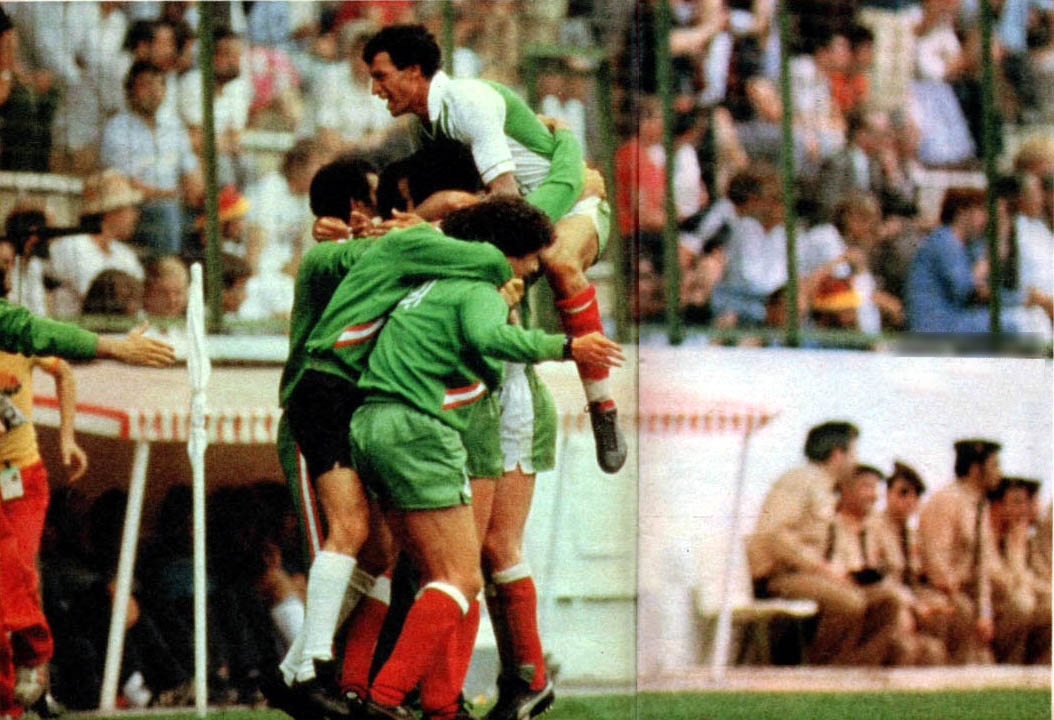
Guillermo Gruben · El Gráfico
And look at the photograph of that team. Its shirt was not Nike, Adidas or Puma. It was Sonitex. Made in Algeria.
Two years earlier, three Sonacome M210 trucks from the Rouiba factory had entered the Paris–Dakar rally. The result seems almost unbelievable today: first, third and fourth places in the truck category. An Algerian industrial company was taking on international competition and winning.
This is not about idealising that period. The centrally administered economy had its cumbersome machinery, failures and dead ends. Algeria in the 1970s and 1980s was no industrial paradise. But it possessed something we may have lost along the way: the conviction that it could make things. Make a truck. Make a shirt. Train a footballer. Build a factory. Create a school. Measure itself against others without assuming in advance that they were better.
Beyond nostalgia
That is why the current return of the 1982 shirt is more interesting than a simple vintage trend. DJ Snake himself recently appeared in an outfit inspired by that aesthetic. What generations had come to dismiss as old-fashioned suddenly becomes desirable.
But the real challenge begins precisely where nostalgia ends. It would be rather sad if “made in Algeria” served only to reproduce objects from the 1980s. The aim is to make new ones.
Algerian economic policy is now explicitly restoring domestic production, industrial integration and reduced dependence on imports to the centre of its priorities. In 2026, the presidency again devoted meetings to protecting domestic production, while the African Development Bank reported progress in several Algerian industrial indicators.
Nothing is fully secured, of course. An industry is not reborn through press releases. It is reborn through quality, training, productivity, innovation, competition and high standards. But something is changing. And that transformation will remain incomplete if it is only industrial. Confidence must also be rebuilt.
Decolonising minds does not mean rejecting foreigners. That would be another form of confinement. It means neither despising expertise from elsewhere, nor pitting Algerians at home against the diaspora, nor buying Algerian products without examining their quality.
It simply means regaining a normal relationship with ourselves. Welcoming a foreign visitor without becoming subservient. Appreciating a compliment without needing it. Importing what we cannot yet produce without assuming we will never be able to produce it. Calling on foreign expertise because it is better, not because it is foreign. And above all, ceasing to believe that a product, an idea, a player or a talent must cross the Mediterranean to acquire value.
In 1962, Algerians showed the world that they were capable of liberating their territory. Perhaps this is the last territory still to liberate: the way we see ourselves.
Loading…