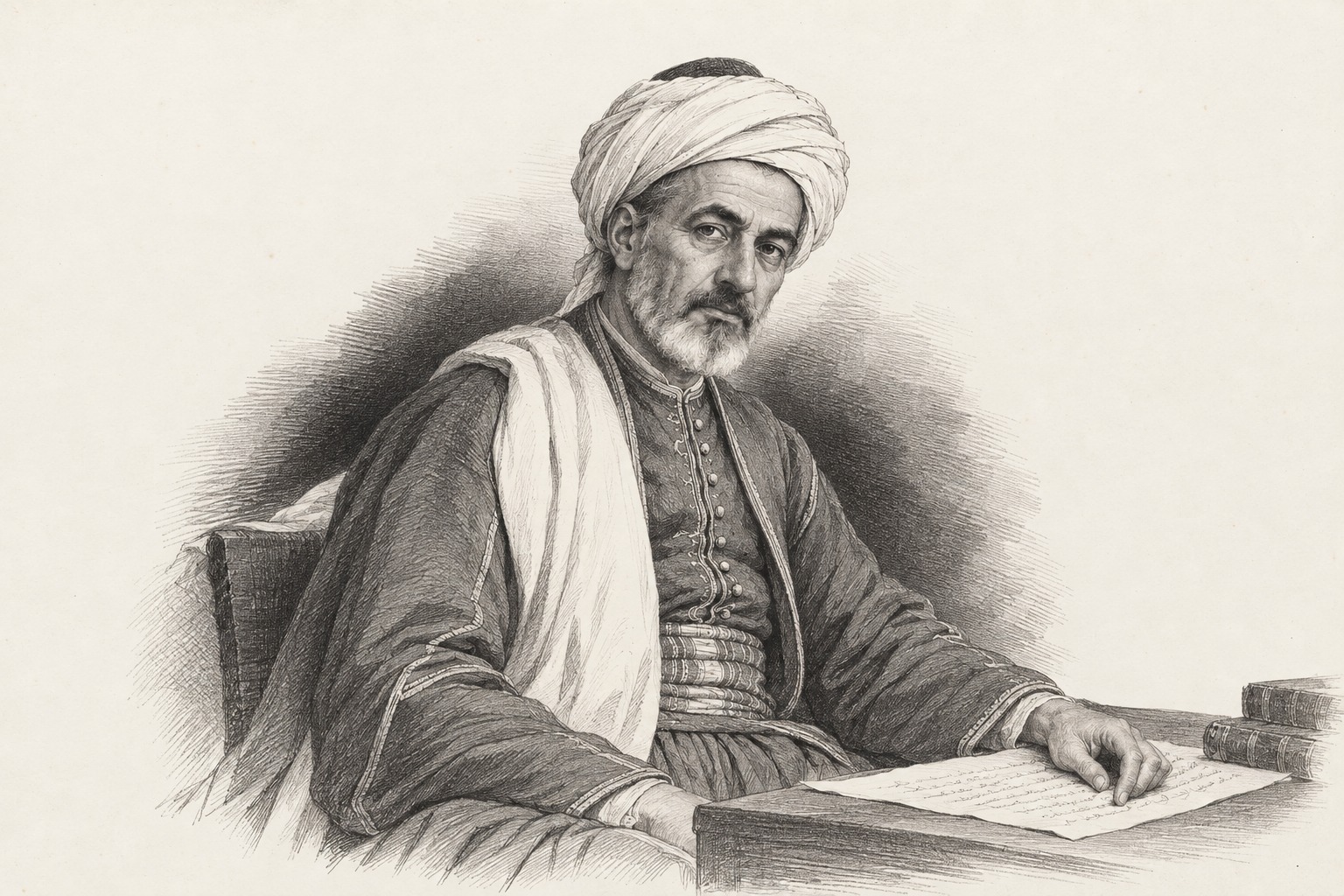
Paris, 23 January 1834. Hamdane ben Othmane Khodja appears before the Commission d’Afrique. An interpreter accompanies him. The commissioners question him about the prospects for the French presence in Algeria. His answers are brief. He doubts that the rural communities south of Algiers will accept this domination; he rules out the prospect of Ahmed Bey submitting.
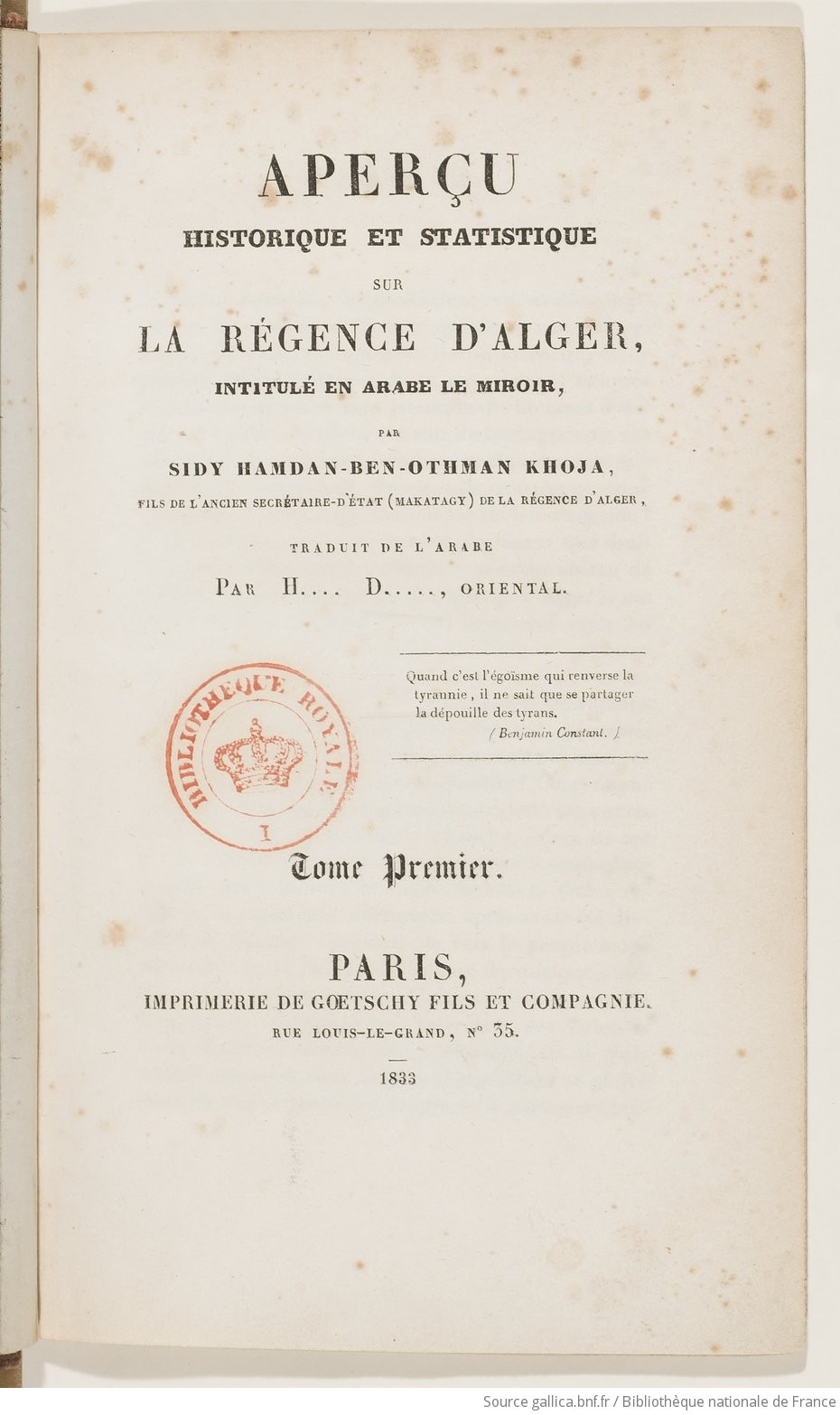
The scene, recounted by historian James McDougall, captures a staggering predicament: an Algerian has come to explain his country to those who now intend to decide its future. His book, Le Miroir — The Mirror — appeared in Paris the previous year. In it, he describes what the conquest is destroying and challenges the conqueror’s right to remain.
Almost two centuries later, this voice speaks to our own time. In the discourse of part of the French right and far right, with Zemmour as a prominent figure and the Bolloré media sphere as a powerful amplifier, Algeria remains trapped in a convenient narrative: before France, the Barbary corsairs; after France, civilisation and the state.
Khodja compels us to reopen the case.
An Algerian who knows Europe
Born around 1773, he belongs to the notable families of Algiers. His father, a jurist and senior official, serves as a secretary and treasurer; his uncle runs the mint. Khodja himself travels, trades and knows the circles of power. In England, he meets the philosopher Jeremy Bentham. His son Hassan studies near London. Here is an Algerian family familiar with Europe before the French army claims to open its doors to them.
This openness sheds light on his struggle. Khodja knows Europe well enough to take its principles seriously and demand that it apply them to others. Why should freedom be a right for European peoples and an improper aspiration for Algerians? Why should military power excuse the breaking of commitments?
Historian Jennifer Pitts shows how far his purpose extends beyond the complaint of a dispossessed property owner: he defends an independent Algeria, capable of taking its place among nations and dealing with them. His resistance takes the form of memoranda, diplomatic initiatives and interventions in French public debate.
In Le Miroir, published in 1833, he begins by giving substance to the invaded country. He describes its inhabitants, regions, activities, customs and organisation. He puts its population at ten million. This is his estimate, not an established census. It reflects an ambition: to portray a society in its breadth at the very moment when conquest threatens to reduce it to a population to be administered. Above all, the Regency possesses a government, fiscal and judicial institutions, and diplomatic relations.
Privateering is not uniquely Algerian: it is practised on the different shores of the Mediterranean, by Christian and Muslim powers alike. Captivity and slavery also belong to this shared history. Reducing Algeria to the “Barbary corsairs” turns practices of the period into an inherent trait of a people, making its cities, institutions, trade and intellectual life disappear behind them. Could we understand France by reducing it to its privateers and slave-trading ports?
Khodja does not describe a lost paradise. He criticises the rulers, their failings and the circumstances of defeat. His testimony bears the interests and limitations of his social milieu. His definition of civilisation is all the more striking: “to be just towards the weak as towards the strong”. The standard is set. It applies to the victor too.
Arguments met with stereotypes
The book proves sufficiently troubling to provoke a response. In June 1834, L’Observateur des tribunaux publishes an anonymous refutation defending General Clauzel. Some have attributed it to the general himself; its authorship has not been established with certainty.
Here the old dispute acquires a striking resonance. To discredit Khodja, the refutation associates him with Barbary pirates, deploys stereotypes of the lazy, money-hungry Algerian, and portrays his denunciations as expressions of hatred towards France. Karl Agerup’s study traces this shift: a debate about the acts of conquest becomes an indictment of the intentions and origins of the person reporting them.
The method is familiar. Anyone documenting violence is confronted with their supposed hostility. Anyone demanding justice is first asked to prove that they love France. The stereotype makes it possible to evade an answer.
Yet Khodja replies. A Réponse à la réfutation — Response to the Refutation — continues this battle in print; it appears in the Sindbad edition of his work. These texts need to be read together: the accusation, the attempt to discredit it, the reply. They reveal an author defending his ability to establish facts and to judge the power imposed upon his country.
He knows the risks. In Le Miroir, he already evokes imprisonment, expulsion and separation from his family. His trust in the justice proclaimed by France coexists with a clear understanding of what its representatives may inflict on him.
Tragedy soon reaches his family. In 1836, his son Hassan is arrested, imprisoned at Bône and then ordered expelled by Clauzel. The dossier studied by McDougall reveals the weakness of the accusations: the administration fears the embarrassment of a trial. Khodja himself leaves Paris and settles in Constantinople. The man who sought people willing to hear him finds himself in exile; his family experiences the violence of the power from which he demanded justice.
His life gives dispossession an intimate dimension. He had travelled in Europe, built relationships and believed it possible to make the case for justice. This familiarity protects neither his struggle nor his family. The France to which he addresses his arguments lets the France that drives them out have its way.
With him, a face of Algeria disappears: a society capable of producing its own descriptions, its political arguments and its critique of the conqueror. Forgetting leaves more room for the crude backdrop of pirates and tribes without history. The erasure of Hamdane Khodja contributes to the erasure of the Algeria that preceded colonisation.
The narratives revived today need not have invented their clichés. They merely have to put them back into circulation, keeping out of view those who were already answering them.
Bringing Le Miroir back into circulation
But readers must be able to find these voices. The Sindbad/Actes Sud edition of Le Miroir is listed as out of stock by a bookseller. An Algerian edition was published by Tafat in 2015: that work exists and deserves recognition. What matters now is lasting availability at an affordable price.
Algerissima calls on Algerian publishers to bring this text back into circulation, alongside the refutation and Khodja’s reply, with notes illuminating the events, discussing the figures and placing the author’s own prejudices in context. An accessible digital edition would be a valuable extension of that publication.
Hamdane Khodja held a mirror up to conquering France. We still need to see what it reveals.
Loading…