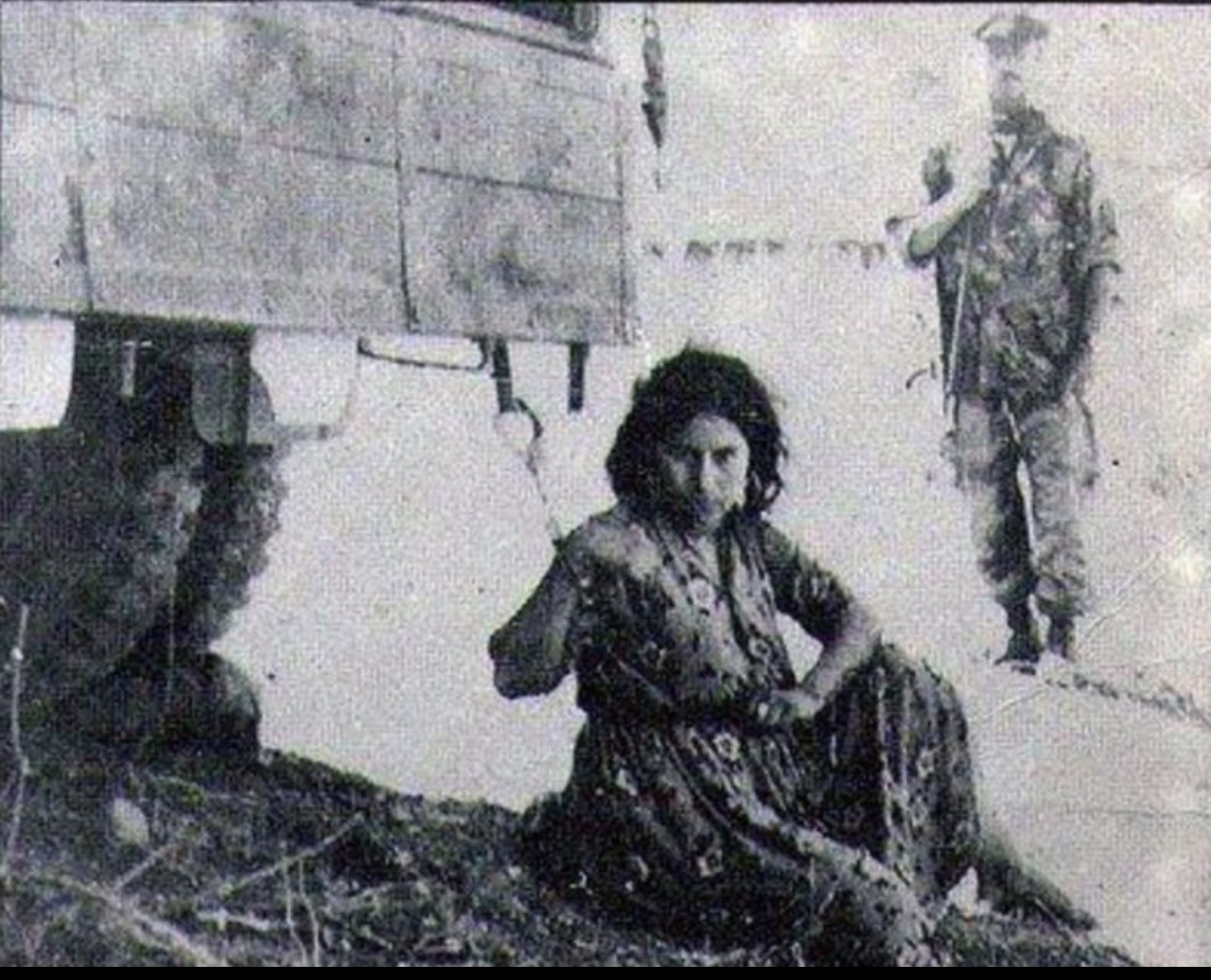
Handcuffed behind a military vehicle, Zoulikha Oudaï looks straight at the camera. She is sitting on the ground. Behind her, a French soldier stands guard. Everything in the scene seems to proclaim her defeat: the truck, the weapon, the handcuffs, the soldier standing beside a seated prisoner. She is being displayed like a trophy.
And yet, almost seventy years later, neither the vehicle nor the soldier is what first catches our attention. It is her gaze. Steady, stern, almost accusing. She does not lower her eyes. She offers the photographer neither the fear nor the humiliation that the scene seems designed to extract from her. Her gaze alone has undone the spectacle of her defeat.
Behind this prisoner lay an underground organisation: women, men, homes and mountain paths. Everything her interrogators would try to make her betray.
A woman leading the resistance
Born Yamina Echaïb in Hadjout on 7 May 1911, Lalla Zoulikha came from a family of local notables. Her father, an educated landowner and municipal councillor, enabled her to receive an education. This educated mother of five could have kept her distance from danger. In Cherchell, she chose to put her resources and authority at the service of independence.
Repression struck at the heart of her family: her husband and one of her sons were executed by French forces. Her son’s name was Lahbib. Those losses did not drive her out of the struggle. Yet it would be reductive to trace her commitment solely to grief: according to Ahmimed Ghebalou’s testimony reported by Echorouk, she was appointed to her leadership role while her husband was still alive. She also committed her family’s financial resources to supporting the FLN.
In his investigation into this “forgotten heroine”, the journalist M’hamed Houaoura describes a political and military organiser whose sector stretched from Menaceur to Hadjret Ennous. She organised women and men supporting the resistance. To join the fighters in the mountains, she entrusted her young children to neighbours.
Her authority cannot therefore be reduced to the image of a courageous woman. She shouldered a responsibility: keeping fighters and their supporters connected, maintaining communications and protecting the people on whom the struggle depended. Capturing such a woman threatened far more than a single life.
The women behind the network
Former activist Assia Benmokadem told Echorouk that the only network members she knew were her sister and her cousin. This compartmentalisation was intended to prevent an arrest followed by torture from exposing the whole organisation.
The women gathered intelligence on military movements, collected money and medicines, and made clothes to be sent to the fighters in the mountains. Zoulikha also welcomed families from the mountains and distributed food and clothing.
Erasing her traces, continuing the struggle
In 1957, the dismantling of part of Cherchell’s network drove her to join the fighters in the mountains. The biographical account of this episode records 54 arrests. She joined Ahmimed Ghebalou and his deputy, Boualem Benhamouda. From the mountains, she continued to lead the women’s network that remained active: leaving the town did not mean abandoning those who carried on the struggle there.
The same account relates that she burned her photographs before leaving; two portraits kept by her sister survived. That detail takes on particular significance when we look at the image of her captivity. Underground life had led her to erase her face from the traces she left behind. The photograph taken under her enemies’ guard would give her, after her death, a presence that time has not erased.
While sheltering with the Hindi family in Sidi Salah, near Menaceur, she helped with harvesting and housework. Mohamed Hindi, who hosted her, explained that she blended into family life while continuing to bring activists together.
This underground existence bears little resemblance to the solitary life suggested by an icon. It depended on ordinary acts that had become essential: opening a door, passing on information, making a garment, keeping silent. In the photograph, that entire world remains outside the frame. Yet it gives the captive’s determination its full weight.
Ten days to break her resolve
Arrested on 15 October 1957, Zoulikha endured ten days of torture. According to Houaoura’s account, she did not betray her companions. On 25 October, the soldiers displayed her before a crowd of local inhabitants. She urged them to continue the struggle until independence, then spat in an officer’s face. The soldiers took her aside and shot her.
Accounts of this scene have also passed down her words. She called on the inhabitants not to give in, and to keep fighting until the national flag flew over their towns and villages. The words attributed to her distil that appeal: “Join the maquis! Free the country!” Her gaze was therefore not her only act of defiance: before her captors, she still found the strength to call for resistance.
The display was intended to discourage resistance. In the testimonies passed down, it became a final act of defiance. The woman they wanted to portray as powerless still found a way to speak to her people. Restraints could not silence her.
The photograph alone cannot reconstruct that final scene. It captures a moment during her captivity whose precise date remains to be established. But what the testimonies tell us about her conduct gives depth to the refusal we read in her eyes.
Recovering her memory
After her execution, there was also the absence of her body. A report on El Moudjahid’s memory forum, published in February 2024, states that her remains were recovered in 1984. Other accounts describe a farmer identifying where he had buried a woman and two men, followed by her reburial in Menaceur’s martyrs’ cemetery. Yet a contradiction remains: in 2016, Houaoura still told El Watan that her grave had not been found. The sources consulted do not resolve this discrepancy.
Time has reversed the image
Those voices had to be recovered. For his Arabic book, “يمينة عوداي البطلة المنسية” — “Yamina Oudaï, the Forgotten Heroine” — Houaoura gathered testimonies over almost ten years, speaking to relatives and former National Liberation Army officials. Her son Mohamed also gave him copies of colonial police records. Behind the familiar face, his investigation reveals a woman who acted, organised and made decisions.
To anyone looking at the photograph today, the soldier remains almost anonymous. The truck is merely scenery. The weapons have become incidental. Zoulikha is still there. What was meant to demonstrate her captors’ power has become an image of her own resistance.
What makes this photograph so powerful is that defiant gaze, inseparable from Algerian “nif”: that blend of pride, honour and refusal of humiliation that demands we stand tall even when all seems lost. In Zoulikha, “nif” ceases to be a pose: it becomes a stance before history.
The handcuffs speak of her captivity. Her gaze remains free. Almost seventy years later, it still defeats the staging intended to show her vanquished.
Watch: “حكايات العابرين — المجاهدة زليخة عدي”, on Al Jazeera. An Arabic-language episode about Zoulikha Oudaï, published on 4 June 2018 — 13 minutes.
Loading…