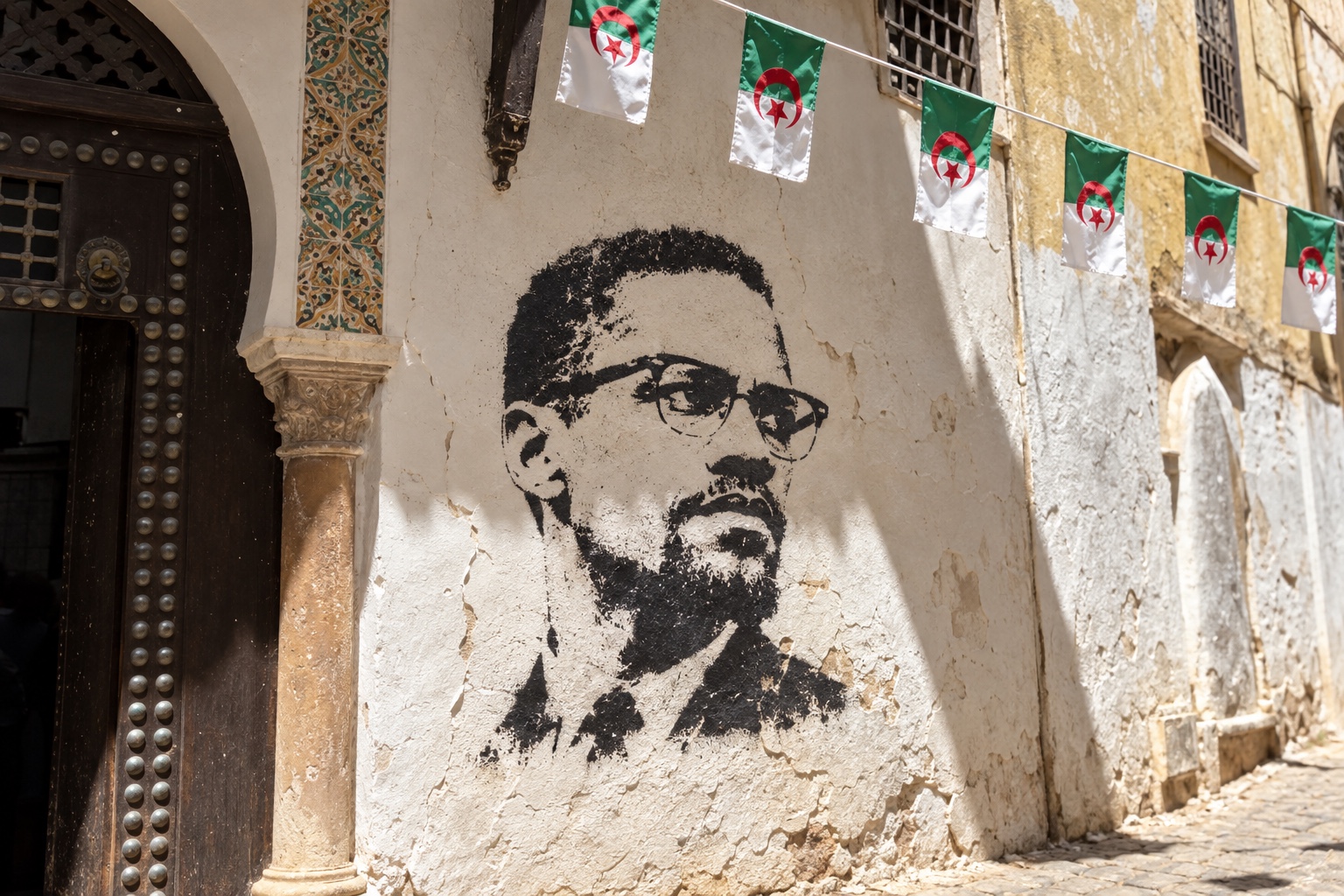
On screen, Malcolm X has Denzel Washington’s face. In Spike Lee’s 1992 film, the pilgrimage to Mecca plays a decisive role: the brotherhood he experiences among Muslims of every colour shakes his old certainties. But another experience, a political one, remains off screen. Neither his stay in Algiers nor his conversation with an Algerian diplomat is shown as part of that transformation.
Nine years later, in Ali, Michael Mann offers a glimpse of this connection. Muhammad Ali, played by Will Smith, meets Malcolm X in Accra, Ghana. Malcolm introduces him to Tahar Gaïd, Algeria’s ambassador, and recommends that he travel to Algeria to meet Ben Bella. The country is named; its representative appears. But the scene centres on a painful reunion between two men separated by Malcolm’s break with the Nation of Islam. What this Algerian contributed to Malcolm’s thinking remains unexplained.
Between the absence in Spike Lee’s film and the fleeting appearance in Michael Mann’s, a story remains to be told. Not the story of an exotic destination added to an itinerary, but of a revolution and an encounter that nourished a mind still evolving.
Some want him to be a Marxist. Others freeze him in the role of a Black nationalist. Still others reduce the Muslim to his conversion, as though faith had ultimately swallowed up political struggle. Each selects the Malcolm X they need. The icon accommodates his heirs’ certainties; the man himself was still able to question his own.
Returning to Algeria does not mean adding a national appropriation to all the others. It means following a lead Malcolm himself left behind. In January 1965, he explained that a conversation with Algeria’s ambassador to Ghana had led him to revise his definition of Black nationalism. The figure barely glimpsed in Michael Mann’s film had thus mattered to the thinking of the man celebrated by Spike Lee.
A revolution he was already watching
Before meeting this diplomat, Malcolm X understood the significance of Algeria’s victory. On 10 November 1963, in Detroit, his Message to the Grass Roots named the Algerians among the peoples who had won their liberation. As he saw it, they had not fought to be accepted into France, but to regain their land and independence. He contrasted that break with an emancipation reduced to gaining access to establishments previously reserved for white people.
What he drew from it was a lesson in power: colonised people had forced a colonial power to yield. Their condition was therefore not inevitable. For a man determined that Black Americans should take control of their own destiny, the example reached far beyond Algeria’s borders.
On 8 April 1964, he also invoked Ben Bella, alongside Nasser and Sukarno, to explain that a man could be Muslim and lead a national struggle. He was already distinguishing his religious convictions from the political platform capable of bringing Black Americans together.
An Algerian’s question
The spring of 1964 transformed his life. In March, his break with the Nation of Islam became final. In April, the pilgrimage to Mecca brought him an experience of brotherhood among Muslims of different colours that his American experience had seemed to rule out. His letter from Mecca bears witness to this: the experience compelled him to reconsider some of his judgements about white people. Islam was central to this opening.
In May, in Kwame Nkrumah’s Ghana, an encounter gave that opening a political dimension. Malcolm X spoke with Tahar Gaïd, Algeria’s ambassador and a veteran of the independence struggle. Eight months later, interviewed on 18 January 1965 by journalists from Young Socialist, he returned to that conversation. He described his interlocutor as a revolutionary in the fullest sense of the word.
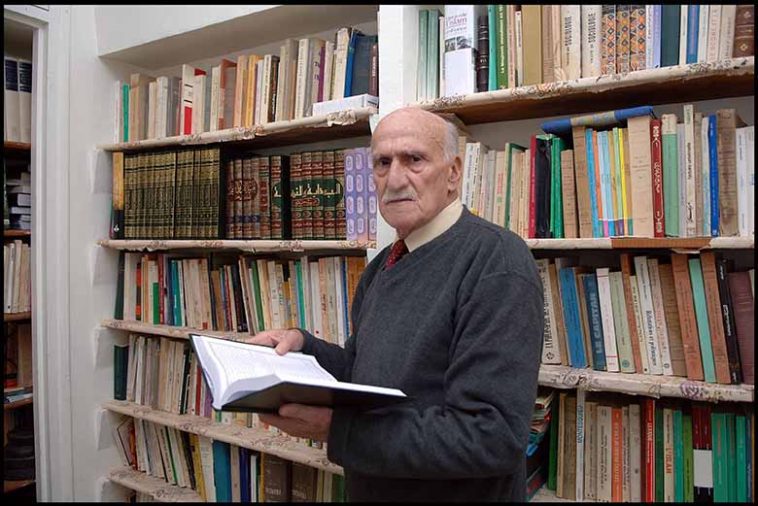
Malcolm had set out his philosophy: Black nationalism. The ambassador then asked what place that definition left for him. He was African, Algerian, committed to fighting oppression; yet Malcolm perceived him as white. Where did he fit? And what of the other revolutionaries who fell outside this colour boundary?
The question struck home. It exposed the contradiction between the breadth of the solidarities he sought and the words he used to define his struggle. He acknowledged this in the interview, whose French translation appears in Le Pouvoir noir: the exchange had forced him to think hard and reassess his definition of Black nationalism.
This was not a tribute reconstructed after his death. Malcolm X himself identified an Algerian interlocutor as one of the men who had led him to revise his thinking.
Fighting a system, not a colour
Tahar Gaïd’s account in Oumma, published in 2017, sheds light on what the ambassador had wanted to convey. He recalled explaining that the Algerian struggle did not confuse the colonial system with the French people. French men and women had supported independence, helped activists and taken risks alongside them. The political dividing line did not therefore automatically coincide with people’s origins.
On the essential point, this late recollection converges with Malcolm’s contemporary account. Gaïd was not asking him to forget the racism his people endured. He was presenting an experience of liberation in which an adversary was defined by participation in domination, and an ally by a commitment to opposing it.
This is where Algeria’s contribution lies. In Mecca, Malcolm had experienced a religious brotherhood that crossed colour lines. In Accra, the discussion concerned the alliances of a revolutionary struggle. The two experiences did not cancel each other out: they complemented one another. Loyalty to one’s own people did not require keeping everyone who might fight alongside them at a distance.
Turning thirty-nine in Algiers
On 19 May 1964, Malcolm X arrived in Algiers. It was his thirty-ninth birthday. In his autobiography, as told to Alex Haley, he recalled the driver who took him to the Aletti Hotel and spoke to him about French violence. Through his encounters, he discovered men for whom revolution was not a word used on a platform, but a recent experience lived in the presence of death.
Ten days later, in New York, the visit informed his address to the Militant Labor Forum. He described the Casbah and drew parallels between colonial oppression and conditions in Black American neighbourhoods. In his reasoning, shared humiliation and exploitation had created a brotherhood of struggle.
Algeria was no longer merely distant proof that victory was possible. It gave him a way of reading Harlem: to place police violence, segregation and dispossession within a worldwide history of domination. The connection was one he made himself.
From Harlem to the world
On 28 June 1964, Malcolm X launched the Organization of Afro-American Unity, the OAAU. His founding address explicitly invoked the model of the Organization of African Unity. The new political organisation was non-sectarian, intended to bring people together across religious divisions. It did not replace his Muslim commitment.
Nor did he abandon independent Black American organisation: he accepted help from white people, but asked them to fight racism within their own communities. Broadening solidarity did not mean handing the leadership of the movement to others.
In July, in Cairo, he sought African leaders’ support in bringing the situation of African Americans before the United Nations. His aim was to make American racism an international human rights issue. Already present in his April speeches, this strategy gained new interlocutors and potential supporters through his travels. Algeria belonged to that wider horizon alongside other African countries; it did not encompass it all.
A mind no one can claim exclusively
In January 1965, Malcolm X strongly attacked capitalism in conversation with his socialist interviewers. Yet in the same interview he acknowledged that he could not yet precisely define the general philosophy needed for the liberation of Black Americans. His thinking was not a finished system to which a label could simply be attached.
On 21 February, he was assassinated in New York. He would not reach forty.
Algeria’s place in his journey need not be exaggerated to be important. A revolution had shown him that domination could be broken. Algerians had given that victory a human face. One of them had led him to question the limits of his own definition of the struggle.
Malcolm X had become no less Black, no less Muslim and no less determined. He had widened the circle of those with whom he could envisage liberation. To those who would claim him in his entirety, that encounter offers a reminder: the man was still willing to question himself, even as his future heirs would seek to freeze him in place.
Loading…